
Measuring skin temperature
Updated onJune 25, 2026
Aidlab can measure skin temperature from the chest while you wear the device.
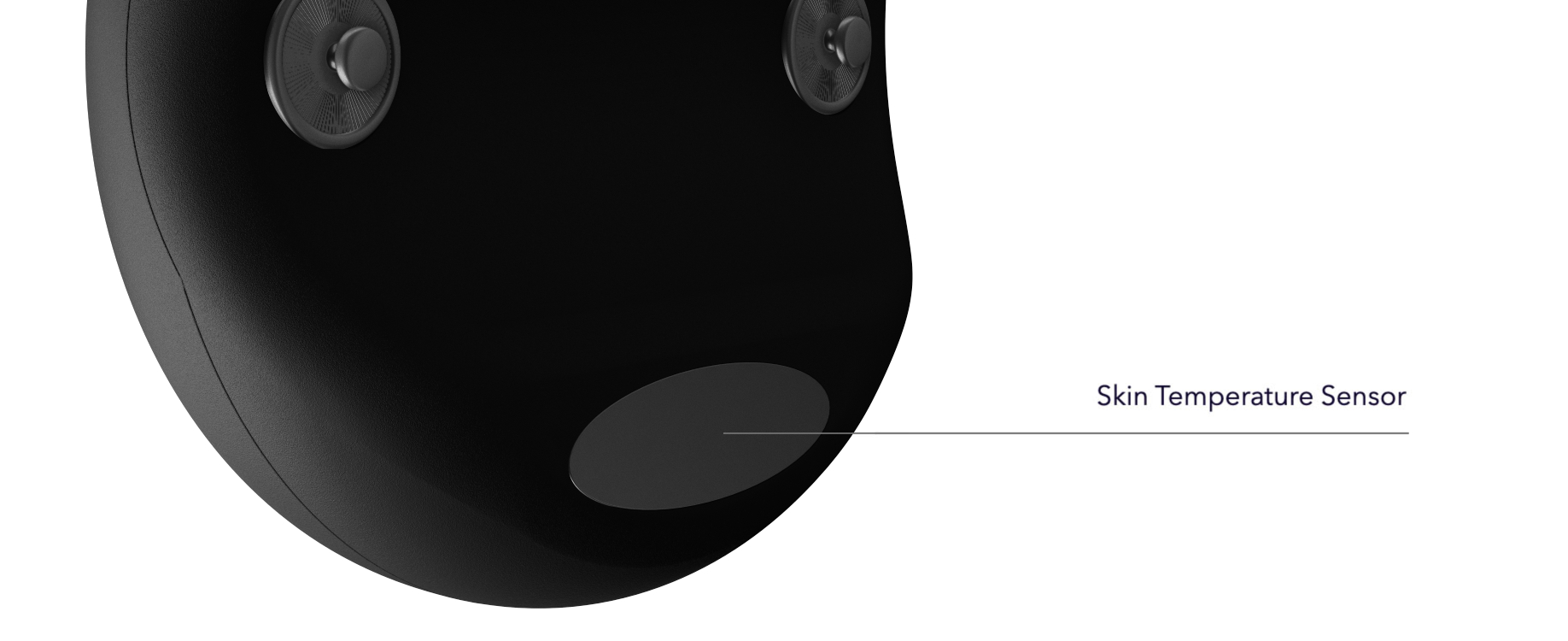
The sensor collects temperature data from the chest, where the skin is relatively thin and blood flow from the area around the heart is close to the measurement point. A reading takes only a few seconds.
What is skin temperature
Skin temperature, often between 32.0-36.3 °C, is a surface temperature reading. It depends strongly on air temperature, time spent in that environment, wind chill, humidity, and time of day. For that reason, a normal skin temperature is better understood as a range, not one fixed value. Some healthy people can naturally read above or below the population average. Skin temperature varies from about 83 °F (28.2 °C) at an ambient temperature of 49 °F (9.5 °C) to 98 °F (37.2 °C) at an ambient temperature of 95 °F (35 °C) [1].
Skin temperature is often confused with core temperature, usually around 37 °C, or general body temperature, commonly between 36.5-37.5 °C in healthy people. These averages do not describe every person equally, because healthy temperature ranges vary.
Quality issues
Several conditions have to be met, as many factors influence this reading:
-
Ambient temperature. The best conditions are room temperature, around 23-25 °C or 73-77 °F. Temperature changes can have a large impact on the reading.
-
Wrong angle. If Aidlab is positioned incorrectly or does not touch the chest properly, the measurement can be unstable.
-
Windy weather. Aidlab works best indoors. Outdoor readings can be less reliable because chest temperature changes with wind, sun, or rain.
-
Thick or scarred skin. Thicker or scarred skin can make the reading harder. If the signal is poor, try adjusting the device position on the chest.
Temperature readings affected by these conditions may be less useful. We continue to improve temperature algorithms and motion detection so future readings can be less sensitive to these factors.
Why should I measure skin temperature?
Skin temperature can help you observe how your body reacts to heat and effort. During exercise, skin temperature can rise over time regardless of the weather. When you run hard, your body produces heat; if it cannot release that heat effectively, overheating can become a risk.
Read more to learn about the relationship between core temperature, skin temperature, and heat flux during exercise in heat [2].
[1] Dr. K.R. Koehler College Physics for Students of Biology and Chemistry, University of Cincinnati
[2] Xu X, Karis AJ, Buller MJ, Santee WR., Relationship between core temperature, skin temperature, and heat flux during exercise in heat.
Aidlab isn’t a substitute for proper medical testing. It isn’t intended as a diagnostic tool and won’t be marketed as such until it receives FDA clearance to allow readings for clinical use.